The ABCs of Stock Market Investing: A Beginner's Guide | Vann Equity Management

The ABCs of Stock Market Investing: A Beginner's Guide
Illustration of stock market basics
Venturing into the stock market can feel like stepping into a vast, uncharted territory. The financial jargon, the dizzying array of options, and the fear of losing money can be daunting obstacles for any beginner. But understanding the stock market is as straightforward as learning your ABCs. This guide breaks down the complexities of stock market investing into three fundamental components: Awareness, Basics, and Commitment.

1. Awareness: Understanding the Stock Market Landscape

The stock market is a marketplace where shares of publicly held companies are bought and sold. When you purchase a stock, you're buying a small piece of ownership in that company, giving you a stake in its success or failure.

What Is the Stock Market?

Imagine the stock market as a giant supermarket. Instead of groceries, the shelves are lined with shares of companies from all over the world. Investors buy and sell these shares, hoping to make a profit based on the company's performance.

Stock market trading floor

Why Invest in Stocks?

  • Stocks historically offer higher returns compared to bonds or savings accounts.
  • Stocks can help outpace inflation, preserving your money’s value.
  • Some companies pay dividends, providing a steady income stream.

Recognizing the Risks

“Stock prices can fluctuate due to economic conditions, company performance, and global events. Awareness of these risks is key to informed investing.”

2. Basics: Building Your Investment Foundation

Before investing, define your financial goals. Are you saving for retirement, a major purchase, or an emergency fund? Clear goals guide your strategy.

Key Investment Terms

Familiarize yourself with basics: Stocks represent ownership; bonds are loans with interest; mutual funds pool money for diversified portfolios; ETFs trade like stocks; diversification reduces risk; and your portfolio is your collection of investments.

Diagram of investment terms
  • Assess risk tolerance: conservative (stability), moderate (balanced), or aggressive (high risk, high reward).
  • Choose the right account: brokerage accounts for flexibility or retirement accounts like IRAs for tax advantages.
  • Diversify across sectors, asset types, and geographies to manage risk.

3. Commitment: Cultivating Long-Term Investment Habits

Start small, even with $100, and contribute regularly. Automating deposits ensures consistency.

Stay Educated and Disciplined

Keep learning through financial news, seminars, and investment communities. Avoid emotional investing by focusing on long-term goals and maintaining discipline.

Investor reading financial news

What This Means:

  • Monitor and rebalance your portfolio to align with goals.
  • Stay informed to adapt to market changes.
  • Patience and consistency drive long-term success.

4. Common Pitfalls to Avoid

Steer clear of mistakes that can derail your investment journey.

Risky Behaviors

Timing the market is challenging, even for experts. Lack of diversification increases risk, and high fees can erode returns. Avoid following trends blindly—conduct your own research.

Chart showing investment pitfalls
  • Avoid timing the market; focus on consistent investing.
  • Diversify to spread risk across assets and sectors.
  • Choose low-fee options to maximize returns.
  • Base decisions on research, not popular opinion.

The Bottom Line

Embarking on your investment journey doesn't have to be overwhelming. By embracing Awareness of the stock market landscape, mastering the Basics of investing, and committing to long-term strategies, you're well on your way to building a secure financial future.

Every expert was once a beginner. Start today with patience, knowledge, and perseverance to navigate the stock market confidently.

This content is brought to you by Vann Equity Management, dedicated to providing insights and guidance to help you achieve your financial goals.

Disclaimer: Investing involves risks, including possible loss of principal. This content is for educational purposes only and does not constitute financial advice nor a solicitation for services. Always consult with a licensed financial professional before making any investment decisions.

Vann Equity Management

Sophisticated Portfolio Solutions for Institutional and Individual Investors

Boost Your Credit Score: Do's and Don'ts | Vann Equity Management

Boost Your Credit Score: Do's and Don'ts

Credit Score Improvement Strategy
A good credit score opens doors to better financial opportunities—from lower interest rates on mortgages to better credit card offers and even improved insurance premiums. Whether you're building credit from scratch or recovering from past mistakes, follow these proven do's and don'ts to boost your score and keep it strong.

Understanding Your Credit Score

Before diving into the strategies, it's essential to understand what makes up your credit score. The FICO score, used by 90% of lenders, ranges from 300 to 850 and is calculated based on five key factors:

Credit Score Ranges

Score Range Rating Impact
800-850 Exceptional Best rates and terms available
740-799 Very Good Above-average rates
670-739 Good Average rates
580-669 Fair Subprime rates
300-579 Poor May be denied credit

The Do's: Building Strong Credit

  • Pay Your Bills on Time: Payment history is the most significant factor in your credit score, accounting for 35% of your FICO score. Make sure you pay all bills by their due date. Set up automatic payments or calendar reminders to never miss a payment.
  • Keep Credit Card Balances Low: Aim to use less than 30% of your available credit, but ideally keep it under 10% for the best scores. High credit utilization can negatively impact your score. This accounts for 30% of your FICO score.
  • Diversify Your Credit Types: A mix of credit cards, loans, and mortgages can positively affect your credit score by demonstrating your ability to manage various types of credit. This credit mix accounts for 10% of your score.
  • Check Your Credit Report Regularly: Regularly reviewing your credit report helps you spot and dispute any errors that could hurt your score. You're entitled to one free report from each bureau annually at annualcreditreport.com.

Pro Tip: The 30% Rule

If you have a credit card with a $10,000 limit, try to keep your balance below $3,000. Even better, keep it under $1,000 for optimal scoring. Remember, this applies to both individual cards and your total credit utilization across all cards.

The Don'ts: Avoiding Credit Pitfalls

  • Don't Close Old Credit Accounts: The length of your credit history matters, accounting for 15% of your score. Keeping older accounts open can help maintain or improve your credit score, even if you don't use them regularly.
  • Don't Apply for Too Much New Credit at Once: Multiple hard inquiries in a short time can signal financial distress, potentially lowering your score by 5-10 points per inquiry. Space out applications by at least 6 months when possible.
  • Don't Ignore Your Debt: Ignoring debt can lead to collections, which can severely damage your credit score for up to 7 years. If you're struggling to pay, reach out to your lenders to discuss payment plans or hardship options.

Warning Signs to Avoid:

  • Missing even one payment (can drop score by 60-110 points)
  • Maxing out credit cards
  • Letting accounts go to collections
  • Filing for bankruptcy (can drop score by 200+ points)

Quick Wins for Credit Improvement

Immediate Actions You Can Take

  • Become an Authorized User: Ask a family member with good credit to add you as an authorized user on their account
  • Pay Down Balances: Focus on cards closest to their limits first
  • Request Credit Limit Increases: This can instantly improve your utilization ratio
  • Dispute Errors: 79% of credit reports contain errors—fixing them can boost your score quickly

How Long Does It Take?

Credit score improvements don't happen overnight, but with consistent effort, you can see meaningful changes:

Expected Timeline

  • 1-2 months: Payment history updates, utilization improvements visible
  • 3-6 months: Consistent payment patterns established, score improvements of 20-50 points possible
  • 6-12 months: Significant score improvements of 50-100+ points for those recovering from major issues
  • 2+ years: Full recovery from bankruptcy or foreclosure begins

The Bottom Line

Building and maintaining a strong credit score is a marathon, not a sprint. It requires consistent good habits, patience, and strategic planning. By following these do's and avoiding the don'ts, you're setting yourself up for better financial opportunities and lower costs throughout your life.

Remember: Your credit score is a tool, not a measure of your worth. Focus on steady improvement rather than perfection, and celebrate the small wins along the way to financial wellness.

This content is brought to you by Vann Equity Management, dedicated to providing insights and guidance to help you achieve your financial goals.

Disclaimer: The information in this article is intended to be general in nature and should not be construed as financial advice. Always seek the guidance of a licensed financial professional for advice tailored to your specific situation.

Vann Equity Management

Sophisticated Portfolio Solutions for Institutional and Individual Investors

📍 Dallas, Texas 📞 (214) 985-0546 ✉️ info@vannequitymanagement.com 🌐 www.vannequitymanagement.com
Unlocking Your Retirement Potential: Navigating 2025 IRA Contribution Limits | Vann Equity Management

Unlocking Your Retirement Potential: Navigating 2025 IRA Contribution Limits

Retirement Planning 2025
Planning for retirement is akin to preparing for a marathon—it requires consistent effort, strategic planning, and an understanding of the course ahead. Individual Retirement Accounts (IRAs) serve as essential tools in this journey, offering avenues to build a secure financial future. As we approach 2025, it's crucial to comprehend the contribution limits and income thresholds that govern these accounts.

Traditional vs. Roth IRAs: Choosing Your Path

Imagine choosing between two routes to the same destination: one offers immediate relief, while the other promises benefits down the line. This analogy mirrors the choice between Traditional and Roth IRAs.

  • Traditional IRA: Contributions are typically tax-deductible in the year they're made, providing an upfront tax break. However, withdrawals during retirement are taxed as ordinary income.
  • Roth IRA: Contributions are made with after-tax dollars, meaning no immediate tax deduction. The advantage lies in tax-free withdrawals during retirement, including both contributions and earnings.

Key Decision Factor:

  • Choose Traditional if you expect to be in a lower tax bracket during retirement
  • Choose Roth if you expect to be in a higher tax bracket during retirement
  • Consider diversifying with both types for tax flexibility

2025 Contribution Limits: Staying the Course

For 2025, the IRS has maintained the IRA contribution limits at the same levels as 2024, providing consistency for retirement savers.

Age Group Standard Contribution Catch-Up Contribution Total Limit
Under 50 $7,000 N/A $7,000
50 and Over $7,000 $1,000 $8,000

Important Note

These limits apply collectively to all your IRAs. For instance, if you're under 50 and contribute $5,000 to a Traditional IRA, you can only contribute $2,000 to a Roth IRA within the same year.

Roth IRA Income Limits: Navigating the Thresholds

Eligibility to contribute to a Roth IRA depends on your Modified Adjusted Gross Income (MAGI). For 2025, the income phase-out ranges have been adjusted for inflation.

Single Filers and Heads of Household

  • Full contribution permitted: MAGI less than $150,000
  • Partial contributions allowed: MAGI between $150,000 and $165,000
  • No contributions permitted: MAGI above $165,000

Married Filing Jointly

  • Full contribution allowed: Combined MAGI less than $236,000
  • Partial contributions allowed: MAGI between $236,000 and $246,000
  • No contributions permitted: MAGI above $246,000

Pro Tip:

  • These thresholds are adjusted annually to account for inflation
  • If your income exceeds these limits, consider a "backdoor Roth" conversion strategy
  • Consult with a tax professional to optimize your contribution strategy

Early Withdrawals: Proceed with Caution

Accessing your IRA funds before age 59½ can be likened to picking unripe fruit—tempting but potentially costly.

  • Traditional IRA: Early withdrawals may incur a 10% penalty in addition to income tax
  • Roth IRA: Contributions can be withdrawn tax- and penalty-free at any time, but earnings withdrawn early may be subject to taxes and penalties

Exceptions to Early Withdrawal Penalties

Certain situations allow penalty-free early withdrawals:

  • Qualified education expenses
  • First-time home purchase (up to $10,000)
  • Unreimbursed medical expenses
  • Health insurance premiums while unemployed
  • Disability or death

Strategic Steps Forward

To maximize your retirement savings and take full advantage of IRA benefits, consider these strategic approaches:

Action Items for 2025:

  • Assess Your Income: Determine your eligibility for Roth IRA contributions based on your MAGI
  • Diversify Contributions: Consider contributing to both Traditional and Roth IRAs to balance immediate tax benefits with future tax-free income
  • Stay Informed: Keep abreast of annual adjustments to contribution and income limits to optimize your retirement strategy
  • Maximize Contributions: Aim to contribute the maximum allowed amount each year to accelerate retirement savings
  • Review Beneficiaries: Ensure your IRA beneficiary designations are up to date

The Power of Compound Growth

Remember: The earlier you start contributing to your IRA, the more time your investments have to grow through compound interest. Even small contributions made consistently over time can result in significant retirement savings.

The Bottom Line

Embarking on the path to a secure retirement requires informed decisions and proactive planning. By understanding the rules governing IRAs—from contribution limits to income thresholds—you can chart a course that aligns with your financial goals.

The 2025 contribution limits may have stayed the same, but your opportunity to build wealth continues to grow. Whether you choose the immediate tax benefits of a Traditional IRA or the future tax-free withdrawals of a Roth IRA, the most important step is to start contributing today.

Remember, retirement planning is not a sprint but a marathon. Each contribution you make today is a step toward financial independence tomorrow.

This content is brought to you by Vann Equity Management, dedicated to providing insights and guidance to help you achieve your financial goals.

Disclaimer: Investing involves risks, including possible loss of principal. This content is for educational purposes only and does not constitute financial advice nor a solicitation for services. Always consult with a licensed financial professional before making any investment decisions.

Vann Equity Management

Sophisticated Portfolio Solutions for Institutional and Individual Investors

What's Moving the Markets: A Fun and Insightful Guide to January 2025 | Vann Equity Management

What's Moving the Markets: A Fun and Insightful Guide to January 2025

Market Analysis January 2025
The stock market is like a giant theme park, with thrilling rides, unexpected twists, and plenty of excitement. Sometimes you're on the roller coaster, zooming to the top with exhilaration; other times, you're stuck on the teacups, spinning endlessly in circles. January 2025 is already shaping up to be an action-packed month, and we're here to guide you through the highs, lows, and everything in between. Let's break down the four key factors driving the markets this month, served with fun insights and memorable analogies.

1. Policy and Politics: The Market's New Backseat Driver

Think of the economy as a long road trip, and government policies as the backseat driver who won't stop giving directions. This month, that driver is more vocal than ever, alternating between stepping on the gas (tax cuts) and slamming on the brakes (tariffs). Investors are watching these moves closely, as they could steer the market in unpredictable directions.

Debt and Deficits

Picture your favorite diner serving up the best pancakes in town. Business is booming, but behind the scenes, the diner is racking up unpaid bills. Eventually, the supplier notices and cuts them off. That's the risk facing the U.S. if deficits and debt grow unchecked. The U.S. Treasury is the world's "go-to" for safety and trust, but running up a tab without showing fiscal responsibility could shake global confidence. Markets thrive on trust—lose it, and things could get bumpy.

Tariffs

Tariffs are like toll booths on the highway of trade. A few tolls here and there might not hurt, but when you hit one every mile, your journey becomes costly and frustrating. Poorly managed tariffs could hurt economic growth by raising prices and reducing trade. On the flip side, well-targeted tariffs can create revenue for the government without significantly disrupting the flow of goods. The balance is key.

Takeaways:

  • Policies that reduce spending responsibly are critical to sustaining market confidence.
  • Poorly managed tariffs could fuel inflation and slow economic growth, but targeted policies may stabilize revenue.

2. Inflation and Interest Rates: The Tightrope Walk of the Century

The Federal Reserve is like a circus performer walking a tightrope, balancing inflation on one side and economic growth on the other. Too much inflation? They raise rates and tighten the rope. Growth slows too much? They loosen the rope by cutting rates. This month, the Fed is balancing carefully, with inflation cooling slightly but still far from its 2% target.

Why It Matters

Inflation is like the temperature gauge in your car. When it overheats, your engine (the economy) risks breaking down. The Fed's job is to keep the temperature just right—warm enough for growth but cool enough to avoid damage. Recent CPI (Consumer Price Index) and PPI (Producer Price Index) data have provided some relief, showing that inflation is cooling. But the pace of improvement is slow, and investors are anxious about whether the Fed will hit pause on rate cuts.

The Risk

If inflation doesn't cool quickly enough, the Fed may delay further rate cuts, leaving markets jittery. Alternatively, cutting rates too aggressively risks fueling inflation again, creating a new set of problems. It's a tricky balancing act, and everyone's watching.

Takeaways:

  • Softer inflation data has given markets a breather, but the Fed's next moves remain uncertain.
  • If inflation remains stubborn, markets could face more turbulence.

3. Market Trends: Winners, Losers, and the Game of Musical Chairs

In the market's current game of musical chairs, some sectors are gliding gracefully while others are scrambling to stay in the game. Defensive stocks like utilities and consumer staples are thriving, offering stability in an unpredictable environment. Meanwhile, high-growth tech stocks are feeling the heat as rising interest rates make their future earnings less attractive.

Winners

Defensive sectors are like comfort food during a storm—reliable, steady, and exactly what you need when times are tough. Utilities, consumer staples, and minimum-volatility stocks have become the safe havens of the market, offering consistent returns even when volatility spikes.

Losers

High-growth tech stocks are the flashy sports cars of the market—exciting, fast, and risky. When interest rates rise, the cost of maintaining these flashy investments becomes harder to justify, causing their valuations to tumble. It's a tough time to be a high-flyer in a rising-rate environment.

Takeaways:

  • Defensive sectors are thriving and offer safe opportunities in uncertain times.
  • High-growth stocks face challenges as rising rates make their future earnings less appealing.

4. Hard Landing vs. Soft Landing: The Economy's Final Approach

Imagine the economy as a plane coming in for a landing. A "soft landing" means the plane touches down gently, with minimal disruption to growth and employment. A "hard landing," on the other hand, feels like a crash—sudden declines in growth, rising unemployment, and turbulence for the markets. Right now, the data suggests we're on track for a soft landing, but challenges like higher interest rates and slowing growth could tilt the balance.

Why It Matters

Solid retail sales and resilient job growth are like the plane's engines humming steadily—signs that the economy is still in good shape. Consumer spending, which accounts for a significant portion of economic growth, has shown strength in recent months, keeping fears of a hard landing at bay. However, the risks remain. Higher interest rates and weaker global trade could still throw the economy off course.

What to Watch

Keep an eye on consumer spending and employment numbers over the next few months. These are the key indicators of whether the economy is cruising toward a soft landing or bracing for a hard one.

Takeaways:

  • A soft landing remains likely, but the risks of higher rates and slower growth could still disrupt the economy.
  • Strong consumer spending and job growth are keeping the economy on a stable path—for now.

The Bottom Line

January 2025 is already delivering thrills and spills in the markets. From the balancing act of inflation and interest rates to the winners and losers in today's market trends, there's plenty to watch as the month unfolds. The economy's final approach—soft landing or hard landing—will depend on how these factors play out.

But remember: just like a roller coaster or a plane ride, the best thing you can do is buckle up, enjoy the ride, and keep your eyes on the horizon.

This content is brought to you by Vann Equity Management, dedicated to providing insights and guidance to help you achieve your financial goals.

Disclaimer: Investing involves risks, including possible loss of principal. This content is for educational purposes only and does not constitute financial advice nor a solicitation for services. Always consult with a licensed financial professional before making any investment decisions.

Vann Equity Management

Sophisticated Portfolio Solutions for Institutional and Individual Investors

When Tariffs Attack: The Surprising Adventures of Import Taxes in America | Vann Equity Management

When Tariffs Attack: The Surprising Adventures of Import Taxes in America

Tariffs and Trade Visualization

Tariffs, Taxes, and Trade—Oh My!

Hold onto your wallets, folks! The aftermath of the U.S. Presidential election has everyone buzzing about the potential rise in tariffs and what that means for our economy.

Picture this: U.S. average tariffs skyrocketing from a modest 3% to a whopping 18%, reminiscent of the 1930s (cue black-and-white footage and flapper dresses). But before we start hoarding canned goods, let's dive into what's actually at stake.

How Do Tariffs Really Work? (Hint: It's Not Magic)

So, what's the deal with tariffs? Think of them as the cover charge at an exclusive club—only this time, the club is the U.S. economy, and the guests are imported goods. An 'ad valorem' tariff means importers pay a percentage of the goods' value as a tax. A 10% tariff? That Gucci bag just got 10% pricier.

Here's what happens next:

  • Shopping Local (Whether You Like It or Not): Imported goods get pricier, so consumers might turn to domestic products or imports from countries not on the tariff naughty list.
  • Price Tags Go Up: Tariffs can lead to higher prices at home. That means your avocado toast might cost more if avocados are imported and taxed.
  • Economy Plays Tug-of-War: Tariffs can both help and hurt economic growth. Domestic producers might celebrate increased sales, but consumers could cut back spending due to higher prices.
  • Trading Partners Feel the Burn: Countries slapped with tariffs might see their exports drop faster than New Year's resolutions.

In short, tariffs are like playing economic Jenga—one wrong move, and things can get shaky.

Economic Jenga Tower
The delicate balance of international trade

The Great Tariff Hike: How High Can They Go?

During the campaign trail, there were whispers (okay, maybe more like loud proclamations) about raising tariffs on China up to 60%. Imagine that—it's like adding hot sauce to an already spicy trade relationship. Some even suggested a blanket tariff of 10% or 20% on all trading partners. Talk about throwing a tariff party and inviting everyone!

Our Baseline Scenario

In our less dramatic baseline scenario, we anticipate more modest hikes:

  • Targeted Tariffs: 10%-25% on metals, cars, and some agricultural products from the EU, Mexico, and Canada.
  • Extra Charges on China: An additional 25% on machinery, electronics, and chemicals.

This would nudge the average U.S. tariff up to about 5% by 2028—not exactly the stuff of economic nightmares, but enough to make international traders sip their coffee nervously.

Trade Wars: The Empire Strikes Back

Tariffs can seriously cramp trade flows. Remember the U.S.-China trade war? It was like a high-stakes game of Monopoly, but nobody passed 'Go' or collected $200. For every 1 percentage point increase in tariffs, imports from China fell by about 2.5%. That's a significant dip!

When the U.S. slapped a 25% tariff on UK Scotch whisky, imports of the Scottish elixir dropped by 33%. That's a lot of untasted whisky and probably a few sad happy hours.

But here's the plot twist—other countries swooped in to fill the gap. China's share of U.S. imports fell from 22% to 14%, while places like Mexico and Vietnam saw their exports to the U.S. jump. It's like when your favorite coffee shop closes, and you reluctantly try a new one, only to find out their lattes are pretty good too.

Inflation and Tariffs: Much Ado About (Almost) Nothing

You might think that higher tariffs would make everything more expensive than a stadium beer, but not so fast! The U.S.-China trade war showed that the impact on inflation was about as small as a chihuahua in a room full of Great Danes.

Estimates suggest that the tariffs raised the U.S. Consumer Price Index (CPI) by at most 0.2%-0.3%. Retailers absorbed some costs, perhaps out of the goodness of their hearts—or maybe to keep customers from fleeing to competitors.

  • 60% Tariff on China: Could raise the CPI by up to 0.7%. That's like adding a few cents to your dollar menu item.
  • 10% Tariff on the EU, UK, South Korea, and Japan: Might bump the CPI by around 0.3%. Time to start a coin jar?

In the grand scheme, these are minor increases. The U.S. economy is like a cruise ship—it doesn't turn on a dime, and small waves won't rock the boat too much.

GDP and Tariffs: A Love-Hate Relationship

Now, about the economy's growth. The U.S.-China trade war didn't sink the ship, but it did slow it down a bit—think of it as hitting a speed bump rather than a brick wall. Most models show the U.S. GDP took a hit of about 0.2%-0.4%. For China, the impact was a bit more dramatic, with GDP drops ranging from 0.3%-1.2%.

But let's be real; these numbers aren't likely to keep policymakers up at night. However, there are a few storm clouds to watch:

  • Retaliation Nation: Other countries might retaliate with their own tariffs, leading to a global game of "Who's Got the Biggest Tariff?" Spoiler alert: Nobody wins.
  • Productivity Puzzles: Higher tariffs could make economies less efficient over time. It's like running a marathon with a pebble in your shoe—not immediately crippling, but not ideal either.
  • Currency Conundrums: Tariffs could strengthen the U.S. dollar, making exports pricier and potentially giving emerging markets a financial headache.

The Silver Lining? (Wait, Is There One?)

Is there any good news in this tariff tale? Well, the U.S. government could rake in extra revenue from the tariffs—about $100 billion per year by 2030. That's enough to fund...well, we'll let Congress decide that one.

But unless this windfall is used to stimulate the economy directly, it might not offset the negative impacts of tariffs. So, it's a bit like finding a $20 bill in your winter coat—you didn't expect it, but it's not going to pay your rent.

Conclusion: To Tariff or Not to Tariff, That Is the Question

Tariffs are a bit like hot sauce—they can add a little kick, but too much might ruin the dish. The potential tariff increases could reshape trade flows, nudge inflation slightly, and have a modest impact on GDP growth. While the risks of an all-out trade war reminiscent of the 1930s seem low, it's a scenario we wouldn't want to replay—no matter how vintage the fashion.

In the end, tariffs are just one tool in the economic toolbox. Whether they're used to build bridges or walls depends on the choices policymakers make. As consumers and businesses, we'll feel the effects—hopefully more like a gentle breeze than a category-five hurricane.

So next time you're shopping and notice a slight price increase, you might just be experiencing the thrilling world of tariffs in action. Exciting, isn't it?

July 2025 Market Insight | Vann Equity Management
Vann Equity Management

Financial Market Insight

📅 July 15, 2025 📊 Monthly Market Analysis 🏛️ Institutional Research

Highlights

Key Takeaways

  • Market Perspective: Navigating Uncertainty with Discipline
  • Market Preview: Do tariffs start to boost inflation this month?
  • July Market Multiple Table: Is the Good News All Priced In?
  • Bitcoin & Crypto Update

Stocks

The S&P 500 hit new highs last week but then declined on Friday and was slightly lower on the week as trade tensions consistently escalated throughout the week and over the weekend.

✓ What is Outperforming: Defensive sectors, minimum volatility, and sectors linked to higher rates have been relatively outperformed recently as markets have become more volatile.

✓ What is Underperforming: Tech/growth and high valuation stocks have lagged as yields have risen.

First and foremost, we hope you and your family enjoyed Happy Independence Day. This recent holiday serves as a reminder of the freedom and resilience that define the American spirit, and so much that we all have to live for. As we celebrate, we also want to express our sincere condolences to the many Texans who were and are currently affected by the devastating flooding in the southern part of our state. Our thoughts are with all those affected.

Market Perspective: Navigating Uncertainty with Discipline

As we move into the second half of 2025, financial markets remain a mixed bag… resilient in some areas, fragile in others. We are still in the midst of a complex transition: inflation continues to ease, but interest rates remain elevated; consumer confidence is improving, but global geopolitical risks continue to cast shadows over the outlook.

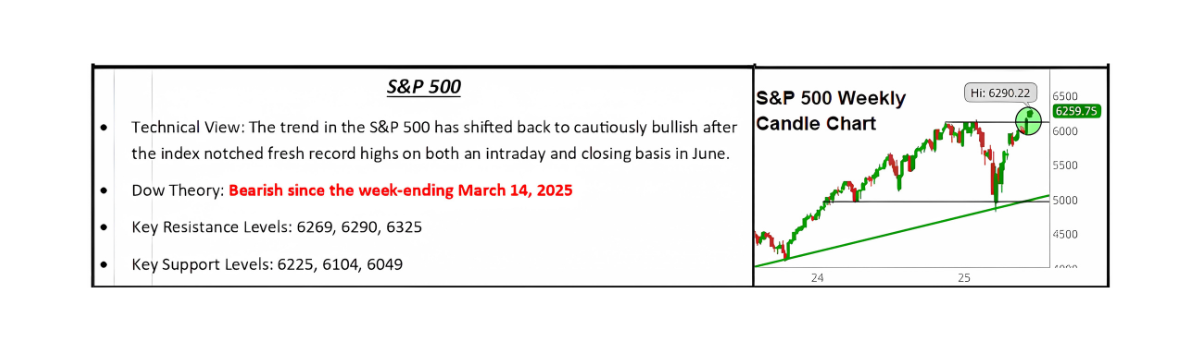
S&P 500 Weekly Candle Chart

To kick off the beginning of the month, President Trump issued letters to several major U.S. trading partners, proposing a significant hike in tariffs. The proposal would raise baseline tariffs on all imported goods from 15% to 20%, up from the current average of about 10%. These new tariffs are scheduled to go into effect on August 1, pending implementation.

However, despite the dramatic headlines, markets barely reacted. The two main reasons are that investors do not believe the tariffs will actually happen, or if they do, they expect them to be rolled back quickly, as they were done earlier this year. The second is that markets ASSUME Trump will not take actions that will seriously damage the economy, especially with stock prices near record highs and growth remaining modest.

The key difference now conversely, the stock market is not punishing the policy threat; it is rewarding it, and Trump has taken note. In recent speeches, he has referenced the stock market's strength as a reason to go even further, suggesting that strong equity performance signals broad support for tariffs. He stated publicly, “People like the tariffs,” and pointed to new market highs as evidence.

This mindset, to our investment teams, introduces real risk. If market strength is interpreted as a green light, more aggressive trade actions MAY follow, and not because the economy can handle them, but because the political optics appear favorable.

So, what Is the Real Economic Risk?

Let us be clear: tariffs at the proposed levels, 15% to 20 % across the board, would be a massive shift in global trade policy. According to the Peterson Institute for International Economics, the average U.S. tariff in 2016 was just 1.6%. A jump to 15 % would be the highest rate since the 1930s.

Tariffs at that level would likely increase inflation, disrupt supply chains, and slow global growth. Major industries such as autos, electronics, agriculture, and retail would be hit hard. In fact, Goldman Sachs estimates that a 15% average tariff on imports could reduce U.S. GDP growth by 0.5% to 1% annually if fully implemented.

Markets may be underestimating the potential damage.

From a portfolio management perspective, this is not a time for fear, but it is a time for precision. It is not about chasing fads or overreacting to headlines. It is about discipline, data, and positioning portfolios for long-term durability in a world that no longer offers free money.

Key Themes We Are Watching Closely:

  1. Interest Rates and Fed Policy: The Federal Reserve has kept rates steady but maintains a hawkish tone. Markets are pricing in rate cuts, but we remain skeptical of any near-term pivot and are looking for only .25pt by year-end. Inflation is not fully tamed, and the Fed will likely error on the side of caution.
  2. Corporate Earnings and Valuation Stretch: While earnings have been strong in several sectors, particularly in the technology sector, the valuation gap between growth and value is now at historic extremes. We are starting to see signs of mean reversion, and we are positioning accordingly.
  3. Credit Markets and Liquidity Risks: We are seeing a quiet tightening of credit standards across banks and lenders. This often precedes a slowdown in capital investment and consumer borrowing. We continue to overweight quality and underweight speculative credit exposure.
  4. International Exposure: Despite U.S. market dominance over the past decade, select international markets (particularly in Asia and frontier economies) are becoming increasingly attractive from a valuation and demographic growth standpoint. International stocks have led performance to the upside year-to-date.

What This Means for Your Portfolio?

We remain focused on:

  1. Risk Management: Adjusting exposure to reduce correlation and maintain liquidity.
  2. Strategic Positioning: Staying overweight quality equities, underweight any deterioration of growth, and tactically allocating value sectors and individual names as appropriate.
  3. Tax Efficiency and Cash Flow Optimization: Maximizing after-tax returns through careful rebalancing and opportunistic harvesting.

We have been living through one of the most uncertain macroeconomic periods since the Great Financial Crisis, but also one of the most opportunity-rich. The winners will be those who stay patient, disciplined, and data-driven. As always, we are here to answer questions, review your strategy, and make adjustments as needed.

Economic Data (What You Need to Know in Plain English)

As we settle into the second half of July, economic momentum continues to grind higher, but investors would be wise not to make mistakes in calm for clarity. Last week was one of the quietest stretches in recent memory in terms of economic data, yet even in that calm, signals beneath the surface reminded us that nothing in this market should be taken for granted.

Jobless claims came in better than expected, with initial filings dropping to a multi-week low. This has become a familiar cycle: claims rise for a few weeks, hinting at a potential labor market breakdown, then reverse and settle back into the low 200,000s. This reinforces the narrative that the labor market remains intact. However, continuing claims told a different story, rising again to levels not seen since 2021. That means unemployed individuals are having a harder time finding work, and while this could be a leading indicator of weakness, it has been trending this way for over a year without triggering broader damage. For now, the labor market remains stable, but it deserves close attention.

The Federal Reserve’s meeting minutes also landed last week, and while some headlines tried to extract a dovish message, the reality was more neutral. A few members voiced openness to cutting rates as early as this month, but that is not the same as a majority view, and the overall tone remained cautious and data-dependent. The Fed’s “wait-and-see” stance remains intact, and market expectations continue to center on a potential cut in September, followed by a second move later in the year, assuming inflation stays in check (our Investment Committee is betting on a .25 pt by the end of the year).

However, the data vacuum ends now. This brings a series of pivotal reports that could quickly reshape market sentiment, especially around inflation and consumer strength. All eyes are on Tuesday’s Consumer Price Index, which is the single most influential data point for near-term monetary policy. Core inflation needs to stay cool. If we see any move back toward 3 percent or higher, the logic supporting a September rate cut will unravel quickly. Bond yields would rise, and concerns that tariffs are feeding inflation could reignite volatility, especially with the August 1 deadline for new trade actions looming.

Later in the week, attention turns to consumer spending. Retail sales will give us a direct read on whether the engine of the U.S. economy is still humming. So far, the consumer has defied skeptics, showing resilience in the face of higher prices, tighter credit, and persistent rate pressure. If that continues, it supports the narrative of a soft landing of slow but sustainable growth. If it cracks, the entire economic outlook will have to adjust.

Additional updates on manufacturing activity and labor market health will also hit the tape. While these smaller surveys and weekly claims data are noisy, large surprises in either direction can be early indicators of shifting momentum. Together, they will either reinforce the idea that growth is cooling in an orderly way or that the Fed has a bigger problem on its hands than markets are currently pricing in.

For now, the foundation remains solid. Labor is steady. Spending has not yet rolled over. Inflation, while still sticky, has cooled from its peak. If this week’s data cooperates, it will further anchor the current rally. But if the numbers disappoint, especially on inflation, the market will quickly reprise, and risk appetite will dry up just as quickly as it returned.

As always, we are watching these developments closely and are ready to adjust positioning if the data calls for it. Please contact us if you would like to schedule a mid-year review or discuss how these dynamics may impact your allocation strategy.

Special Reports and Editorial

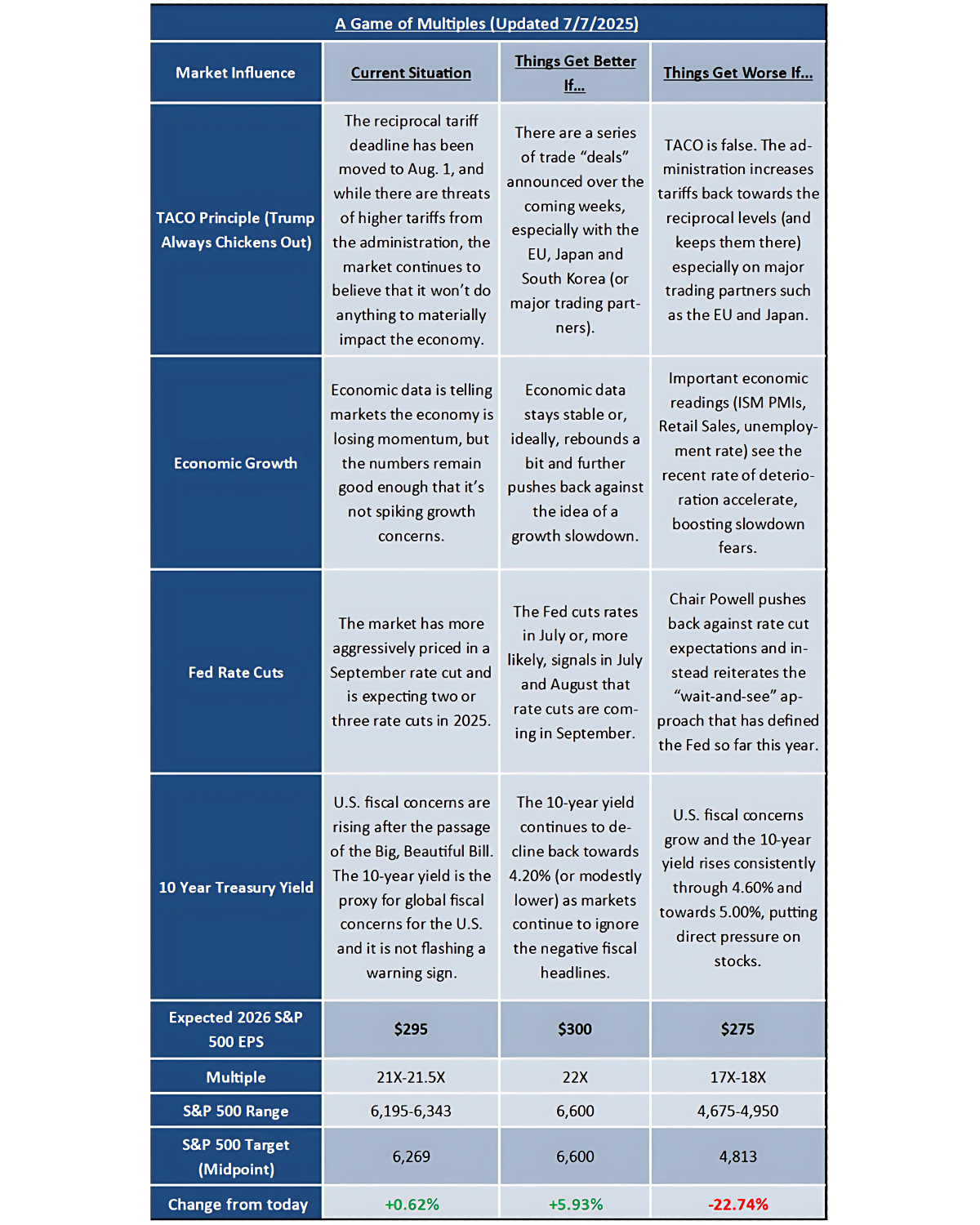
July Market Multiple Table: Is the Good News All Priced In?

The July Market Multiple Table largely reinforces our fundamental view of this market: In the short term, a series of positives has pushed stocks legitimately higher. But at this point, the market is assuming almost universally positive resolution of the major issues impacting them, as well as above-average annual earnings growth, and if any of those assumptions are incorrect, then any drop towards fundamental support could easily reach 10% on a pullback.

What has changed? Earnings and Fed Rate cuts. The first important change to the July MMT compared to June is the adoption of 2026 S&P 500 earnings estimates (at the bottom of the table). The consensus S&P 500 earnings expectation for 2026 is $295/share (Factset), which is up some 30-ish dollars from the 2025 S&P 500 earnings estimate, which is around $265. That’s more than 10% earnings growth and solidly above the 7%-8% longer run average. Positively, this switch to 2026 numbers makes the S&P 500 more justifiably valued at current levels (although still expensively valued historically). Nevertheless, that aggressive earnings growth seems especially bold, given the unknown impacts of tariffs, delayed Fed rate cuts, and an economy that is clearly losing momentum. Short term, the switch to 2026 numbers (which is appropriate given the calendar) eases the valuation issues with this market, but underscores just how much good news is already priced into stocks.

The second notable change in the MMT is that expectations for Fed Rate Cuts have replaced inflation as a market influence. Importantly, that does not mean inflation will not still impact this market if CPI or the Core PCE Price Index jump, but it does reflect the fact that over the past month, market expectations for a rate cut in September have helped power stocks higher. Our team thinks that rate-cut expectations were a major contributor to the “melt-up” we saw in stocks during the last two trading weeks of June. The market now expects two to three rate cuts from the Fed this year, with the first coming in September. That expectation has helped the S&P 500 hit new highs, but it also creates the potential for disappointment if Powell sticks to the “wait-and-see” policy the Fed has employed YTD.

What’s the MMT Say About Valuations? The rally to new highs is justified by fundamental positives, but at these levels, the market continues to assume a lot of positive resolutions on key market unknowns (trade, economic growth, Fed rate cuts, fiscal concerns, and earnings growth).

A Game of Multiples Table

For the past several weeks, our investment team has said the market’s rally has been, in part, driven by an early “switch” for 2026 S&P 500 EPS numbers and the July MMT validates that statement, as the valuation of the market using 2026 earnings is more appropriate given the current set up. To that point, there has been legitimate positive news over the past several weeks: Easing trade risks, stable growth, the likelihood of near-term rate cuts, and geopolitical de-escalation. That, combined with momentum, legitimately pushes stocks higher.

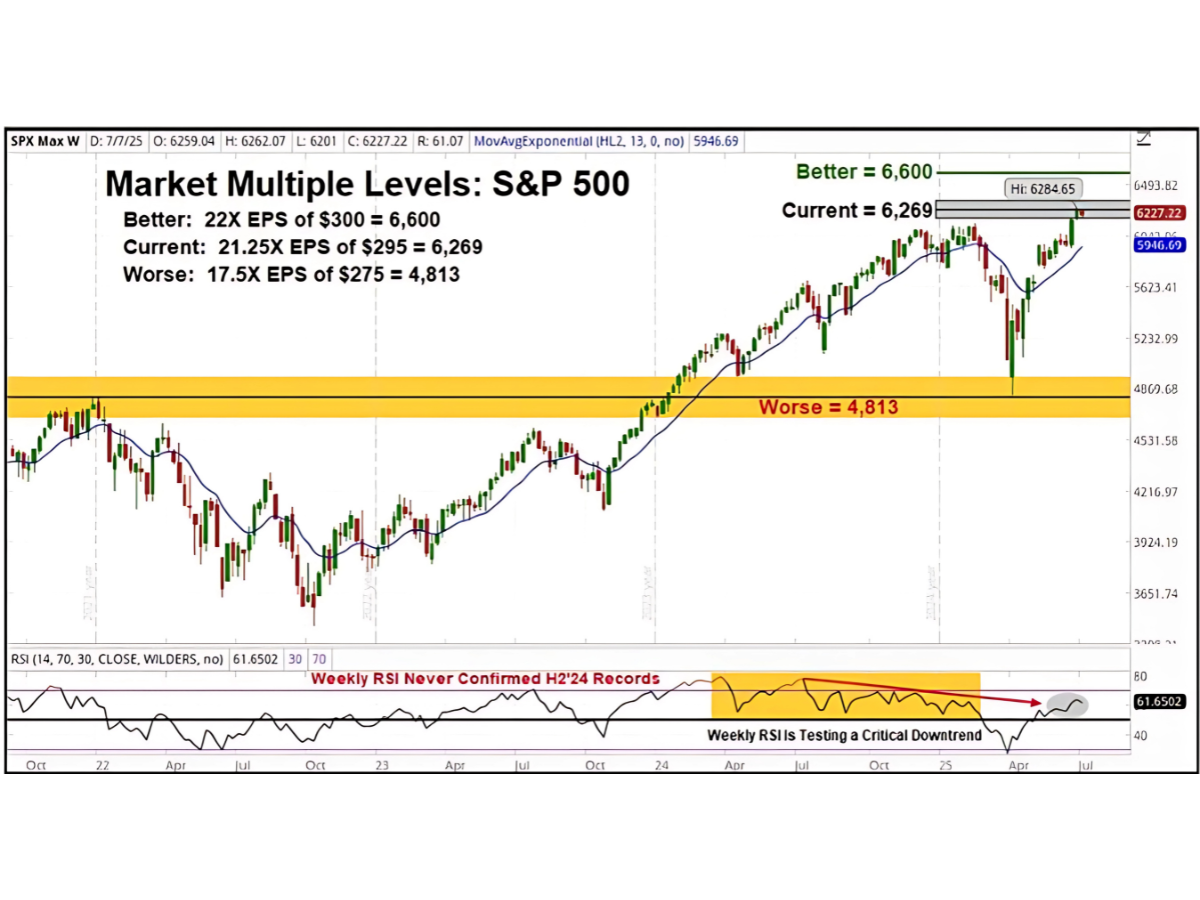
But the S&P 500 is now trading above 2026 S&P 500 earnings, earnings that assume substantial year-over-year growth (above 10%) and, even then, leave only a bit of upside if we get a near-perfect resolution on tariffs, economic growth, Fed policy, global bond yields, and earnings. Our team is not saying that is possible, but we are saying that a lot of the good news that can happen over the next six months is now mostly priced into stocks. That does not mean stocks have to decline, but it does mean they are vulnerable to disappointment on a series of fronts (again, tariffs/trade, growth, Fed rate cuts, rising yields, and earnings). That is the mindset we have to be in right now in this market: Yes, there have been some positives, and stocks are not ridiculous at these levels. But we are once again in a situation where any disappointment on the major influences will cause an air pocket-type decline of at least 5% (and probably more).

Market Multiple Levels Chart

Current Situation: TACO remains in place and is helping the market to ignore tariff threats, deadlines, and most other controversial economic headlines. Economic growth continues to slow but is still “ok.” Markets do fully expect a September rate cut (and another one or two before year-end), and despite the Big, Beautiful Bill passing, the global bond markets are not expressing any fiscal concerns. This environment represents a positive resolution (albeit temporary) to more market influences, and as such, the rally to new highs is fundamentally legitimate, although now the market is pricing in a near-best-case scenario.

Things Get Better If: There are a series of trade deals announced over the coming weeks that further reduce tariff risks, economic growth remains stable or rebounds, the Fed signals rate cuts are coming in September (or does a surprise cut in July) and the 10-year yield stays around or below 4.50%, reflecting fiscal calm despite the Big, Beautiful Bill. This is basically a perfect outcome for markets and would almost certainly fuel a move towards the mid-6,000s in the S&P 500.

Things Get Worse If: TACO is invalidated and reciprocal tariffs rise, economic growth slows further and increases slowdown concerns, the Fed does not cut rates and sticks with “wait and see,” and the Big, Beautiful Bill increases fiscal concerns and pushes the 10-year Treasury yield towards 4.60%. This outcome would effectively reverse the positive progress over the past two months and put trade-war-driven stagflation back on the table and resulting in a sharp decline in stocks and bonds.

Bitcoin & Crypto Update

We offer an update on the Bitcoin/crypto landscape, because while it is not appropriate for all clients, it is becoming an increasingly popular asset. Therefore, we want to make sure you are kept up to speed on events in this market, so any conversation about Bitcoin/cryptos can be an opportunity to impress.

  • Bitcoin Milestones: 1) Bitcoin stayed above $100K for 30 consecutive days for the first time ever. 2) ~99% of Bitcoin addresses were in profit. 3) Bitcoin supply on exchanges fell to a new low.
  • Domestic State Bitcoin Adoption: U.S. state officials discussed, proposed, advanced, or passed legislation to add Bitcoin as a strategic reserve asset, including Arizona (the state’s House of Representatives approved House Bill 2324, creating a framework for a “Bitcoin and Digital Assets Reserve Fund” – awaiting Gov. Hobbs’ signature), Ohio (time to establish a state Bitcoin reserve, according to Rep. Demetriou, with House Bill 18 in committee) and Texas (the third U.S. state to adopt a Bitcoin reserve fund after Gov. Abbott signed SB 21 into law). In contrast, Connecticut enacted a new law banning state and local governments from holding, investing in, or accepting crypto assets.
  • Industry Advances: 1) Renowned financial advisor Ric Edelman recommended investors allocate between 10% and 40% of their portfolios to crypto. 2) Kraken launched Kraken Prime (offering institutional clients access to crypto trading, custody, and financing through a single platform) and Krak (a P2P payments app enabling users to send and receive payments in 300+ currencies, including cryptos, to 110 countries.) 3) SoFi will relaunch spot trading for BTC and ETH later this year. 4) FTSE Russell, Eurex, and CBOE launched nano and reduced-value crypto futures (more cost-effective) for Bitcoin and Ethereum. 5) Chainlink teamed up with payments provider Mastercard to allow the credit card company’s 3B cardholders to buy crypto on-chain. 6) The Bank of Russia announced that financial institutions can now offer crypto-linked derivatives to qualified investors. 7) A Coinbase survey reported that blockchain initiatives have been adopted by 60% of Fortune 500 companies (with 20% of executives considering on-chain initiatives a key part of their long-term strategy, up 47% from last year)… A third of small- and medium-sized U.S. firms are now using crypto (2X the number in 2024)… And more than 80% of institutional investors plan to increase their crypto exposure this year.
  • Noteworthy ETF News: 1) South Korean authorities submitted a detailed roadmap for the approval of spot crypto ETFs. 2) JPMorgan plans to accept crypto ETF shares as collateral for loans and include crypto holdings in clients’ net worth assessments. 3) New launches: Global X Bitcoin Covered Call ETF (BCCC), Nicholas Crypto Income ETF (BLOX), REX MSTR Growth & Income ETF (MSII), REX COIN Growth & Income ETF (COII), and Bitwise GME Option Income Strategy ETF (IGME). 4) Multiple issuers filed – or saw proposals advance – for a variety of crypto ETFs, including Yorkville America Digital/Trump Media & Technology Group (BTC), Trump Media & Technology Group (BTC+ETH), CoinShares (SOL), Invesco/Galaxy Digital (SOL), 21Shares (SUI), ProShares (CRCL leveraged) and Bitwise (CRCL option income). 5) The SEC extended review periods for multiple crypto ETF proposals to July, including Bitwise’s DOGE ETF, Grayscale’s DOT ETF, Canary Capital’s HBAR ETF, and multiple Solana ETF filings.
  • Notable IPO Activity: Stablecoin issuer Circle went public on the NYSE, rallying 750% in less than three weeks since its IPO. Crypto exchange Gemini filed a confidential S-1 with the SEC for a potential IPO. Crypto exchange Bullish confidentially filed paperwork with the SEC for an IPO. Crypto exchange OKX is considering a U.S. IPO. Crypto prime brokerage FalconX is pondering an IPO. Crypto custody firm BitGo is considering an IPO. Crypto trading platform Uphold is exploring a potential U.S. IPO. Justin Sun-founded blockchain project Tron reportedly plans to go public through a SPAC.
  • Stablecoin Interest: Numerous companies are exploring the use of their own stablecoins or allowing stablecoins as payment options, including Amazon, Apple, Airbnb, X, Shopify, Uber, Walmart, JPMorgan, DTCC, Societe Generale, Deutsche Bank, SoFi, Stripe, Fiserv, Revolut, KB Kookmin (South Korea’s largest bank), Shopify, Ant International, and JD.com.
  • Regulatory Moves: 1) The U.S. House Committee on Financial Services advanced the CLARITY Act, a crypto market structure bill, which heads to the full House floor for a vote. 2) The U.S. Senate advanced the GENIUS Act, the country’s first stablecoin regulatory framework, which heads to the House. 3) The Federal Reserve eliminated “reputational risk” as a factor in bank exams, aligning with the OCC and FDIC in removing a key regulatory barrier that critics say fueled discriminatory debanking of crypto firms. 4) The U.S. Federal Housing Finance Agency issued an order to count Bitcoin (and crypto) as an asset for a mortgage, also directing Fannie Mae and Freddie Mac to consider the cryptocurrency assets of borrowers for the purposes of collateral on single-family home mortgage loans. 5) International headway: Brazil, UK, Japan, Hong Kong, South Korea, Vietnam, Thailand, Philippines, Malaysia, Pakistan, and Kazakhstan all took steps towards backing or advancing digital assets or blockchain technology.

Ready to Navigate These Markets Together?

Schedule your portfolio review to discuss how these market dynamics may impact your allocation strategy.

Schedule Your Review

Disclaimer: The Financial Market Insight is protected by federal and international copyright laws. Vann Equity Management is the publisher of the newsletter and owner of all rights therein and retains property rights to the newsletter. The Financial Market Insight may not be forwarded, copied, downloaded, stored in a retrieval system, or otherwise reproduced or used in any form or by any means without express written permission from Vann Equity Management. The information contained in Financial Market Insight is not necessarily complete and its accuracy is not guaranteed. Neither the information contained in Financial Market Insight, nor any opinion expressed in it, constitutes a solicitation for the purchase of any future or security referred to in the Newsletter. The Newsletter is strictly an informational publication and does not provide individual, customized investment or trading advice. READERS SHOULD VERIFY ALL CLAIMS AND COMPLETE THEIR OWN RESEARCH AND CONSULT A REGISTERED FINANCIAL PROFESSIONAL BEFORE INVESTING IN ANY INVESTMENTS MENTIONED IN THE PUBLICATION. INVESTING IN SECURITIES, OPTIONS AND FUTURES IS SPECULATIVE AND CARRIES A HIGH DEGREE OF RISK, AND SUBSCRIBERS MAY LOSE MONEY TRADING AND INVESTING IN SUCH INVESTMENTS.

© 2025 Vann Equity Management. All rights reserved.

ESG Investing: Considering Values and Potential Returns

1. ESG Investing: Considering Values and Potential Returns


Important Information: This article is for educational purposes only and should not be considered financial advice. Investment decisions should be based on your individual circumstances and after consulting a qualified financial advisor. All investments carry risk.


Environmental, Social, and Governance (ESG) factors are increasingly influencing investment considerations globally, including within Australia. This educational piece explores how these factors are shaping investment landscapes.


Understanding ESG Factors:

ESG investing involves considering environmental impact, social responsibility, and the quality of a company’s governance when making investment decisions. Interest in this approach has grown as investors and stakeholders become more aware of the broader impact of businesses.


Performance of ESG Strategies:

The performance of investment strategies that integrate ESG factors is a subject of ongoing analysis. Various studies have examined the potential relationship between ESG considerations and investment returns. It is important to note that past performance is not indicative of future results, and different ESG strategies can have varying outcomes.


Potential Impact on Long-Term Portfolio Returns:

Integrating ESG factors may influence long-term portfolio returns through various mechanisms. For example, companies with strong ESG practices may be better positioned to manage risks and opportunities related to climate change, resource scarcity, and social trends. However, the specific impact on returns can vary depending on the investment strategy and market conditions.


Conclusion:

ESG investing represents a growing area of focus for investors in Australia and around the world. Understanding the principles behind ESG and the ongoing analysis of its potential impact can be valuable for investors considering a range of factors in their investment decisions.

An Introduction to Portfolio Diversification in Modern Markets


Important Information:

This article is for educational purposes only and does not constitute investment advice or a recommendation. All investments involve risk, including the possible loss of principal.

The principle of not putting all your eggs in one basket is a cornerstone of investing. This concept, known as diversification, has evolved as global markets have become more interconnected. Modern diversification involves strategic approaches that aim to manage risk across various market conditions.

This educational overview explores several concepts related to portfolio construction in today’s markets.

Exploring Concepts Beyond Traditional Asset Allocation:

A basic portfolio might include a mix of stocks and bonds. However, a deeper approach to diversification may involve considering the following areas. It is important to remember that none of these strategies can guarantee profits or protect against losses.

  • Geographic Diversification: Limiting investments to a single country can create concentration risk. Expanding to include international markets may offer access to different economic cycles and growth drivers. However, international investing involves its own unique risks, such as currency fluctuations and political instability.

  • Sector and Industry Diversification: Within the stock market, different sectors (e.g., technology, healthcare, energy) perform differently depending on the economic environment. Spreading investments across various sectors is a technique used to avoid over-concentration in a single area that may face a downturn.

  • A Look at Alternative Asset Classes: Some portfolio strategies incorporate “alternative assets” that may behave differently from traditional stocks and bonds. These can include private equity, commodities, or real estate. Such assets often come with higher fees, greater complexity, and may be illiquid (meaning they cannot be easily sold). Their inclusion requires careful consideration of their specific risks.

  • Factor-Based Investing Concepts: This is an investment approach that involves targeting specific drivers of return, known as “factors.” Academic research has identified several factors, such as “value” (investing in companies that appear undervalued) or “quality” (investing in companies with strong balance sheets). Strategies based on these factors are complex and there is no certainty that they will outperform in the future.

  • Currency Considerations: For portfolios with international assets, currency exchange rates can impact returns. Holding assets denominated in different currencies is one way to manage this, but it also introduces its own set of risks.

A Note on Hypothetical and Past Performance

This article does not discuss the performance of any specific investment. When reviewing any investment materials, it is crucial to understand that past performance is not a reliable indicator of future results. Any hypothetical or back-tested performance has inherent limitations and does not reflect actual trading.

Conclusion

The concepts discussed above provide a brief overview of the evolving nature of portfolio diversification. Building and managing a portfolio is a complex process that depends heavily on an individual’s financial situation, investment objectives, and tolerance for risk.


General Disclaimer

This content is for informational and educational purposes only and should not be construed as investment, financial, legal, or tax advice. The information presented is not a recommendation, offer, or solicitation to buy or sell any securities.

All investing involves risk, including the possible loss of the principal amount invested. There is no guarantee that any investment strategy will be successful. Past performance is not an indication or guarantee of future results. The views and opinions expressed in this article are those of the author and do not necessarily reflect the official policy or position of any company. You should consult with a qualified professional before making any investment decisions.


Explanation of Changes Made to Comply with Rules:

  1. Clear Disclaimers: A prominent disclaimer was added at both the beginning and the end, stating the educational nature of the content, that it is not advice, and that all investing involves risk.

  2. Removal of Promissory Language: Words like “resilient,” “weather volatility,” and “capture growth” were removed. They were replaced with more neutral, compliant language like “aims to manage risk” and “navigate various market conditions.”

  3. Fair and Balanced Presentation: For every diversification strategy mentioned, a corresponding risk was also stated (e.g., international investing has currency and political risks; alternative assets can be illiquid and complex).

  4. No Directives or Recommendations: The language was shifted from instructional (“Learn how to…”) to descriptive (“This educational overview explores…”). This frames the content as informational rather than advisory.

  5. Performance Mention: A specific section was added to clarify the rule about past and hypothetical performance, stating that past results do not indicate future returns.

  6. No Restricted Terminology: The text avoids absolute terms like “secure,” “guaranteed,” or anything that implies a certain outcome.

  7. General Tone: The overall tone is cautious and educational, which is appropriate for a financial services company aiming to inform rather than persuade.

Welcome to WordPress. This is your first post. Edit or delete it, then start writing!